If tonglen ultimately includes all beings, why is it often so difficult to include ourselves?
The practice of tonglen is fairly well known among students of Tibetan Buddhism. However, it is very common for even seasoned practitioners to meet difficulty when practicing tonglen for themselves, usually focusing on external beings or conditions, thereby reinforcing a dualistic view within a practice that points toward non-separation between self and other. Why is it often so difficult to include ourselves?
Tonglen is a compound Tibetan word mirroring the activity of our breath.
- Len (ལེན་, len): To receive, take in, accept, or adopt. The inhale.
- Tong (གཏོང་, gtong): To give, send out, let go, or release. The exhale.
As such it is known as the practice of giving and receiving. Also sometimes the practice of exchanging self for other.
Quite contrary to the classic “out with the bad air, in with the good air,” in tonglen practice we inhale the dark, thick, smoky texture of someone’s discomfort or suffering and exhale the clear light of liberation or freedom from that suffering. This is generally done with individual beings near and dear to us initially and slowly expands to include acquaintances, strangers, and folks with whom we have difficult relationships or find distasteful (I’m sure you can think of at least one such person).
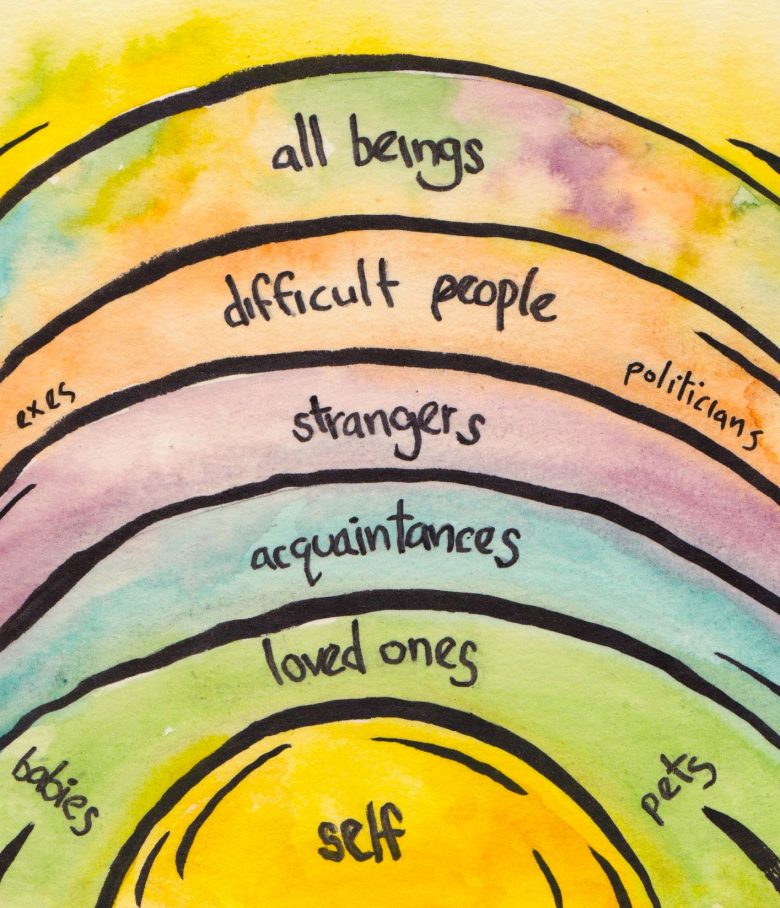
Ultimately the practice can expand, in concentric circles, to include all beings. Of course, taking in the suffering of the world and transmuting it to equanimous joy is a tall order but we can see this as the aspiration of the practice. This is the activity of enlightened beings, bodhisattvas like Chenrezig; aka. noble Avalokiteshvara, bodhisattva mahassatva (great enlightened being). Side note: these same noble qualities live within us as well.
As I have been taught, this does not have to be a monumental task. We do not want to set ourselves up for failure here. This could be as simple as bringing to mind a friend who is ill, inhaling with your tender heart their pain; and exhaling while bringing to mind the same friend, healthy, happy, and engaged in an activity that they love. Another example might be to bring to mind the unhoused person we drive by regularly, breathing in their hunger and cold; and breathing out a hot bowl of soup and wool mittens. This can even be done “on the spot” when we come in contact with a situation like this out in the world.
This second example, of course, is something we could actually do; and maybe this practice can open our hearts and minds such that we undertake this sort of beneficial activity, beyond the cushion, in a safe and productive way.
Tonglen is a practice I do regularly and one that I like to share with my meditation students once they have established a grounded, regular sitting practice. As always reading is one thing, but practicing somatically and experientially under guidance is another. Additionally I like to express that this is a practice that we should do gently with a light touch, especially at first, so that we are not causing ourselves undue suffering while aspiring to help others.
It is natural and common for folks practicing tonglen to experience resistance on the two extreme ends of these concentric circles. Difficult people for whom we feel strong negative emotions, near the outer rings. And ourselves, at the center of the mandala. This very thing came up in conversation during a recent group meditation, as we were coming together for the Sunday morning sit I host on Zoom.
To address the difficulties being expressed, I shared a practice in which I blend the Eastern tonglen practice with a Western psychotherapy modality known as Internal Family Systems or IFS. The intention of this practice is to forge a deeper connection with the center of the mandala and blending these two modalities just seemed like a natural way to do so.
While a deep dive into IFS is out of the scope of this talk/post and I am not trained in it, I have spent the last three years working with it as a client and can say the following with confidence. In IFS we recognize a core Self (which I map to the Mahayana principle of innate goodness, or buddha nature). This core Self (with a capital “S”) is our true, capable, strong, loving, wise self. Around this Self is a constellation of aggregate parts. These parts take on various roles in our psyche and are usually directed by, triggered, or sourced from past versions of ourselves; often traumatized and stuck, or “burdened” as is often said in the IFS framework.
The Practice
Begin by setting the ground with a round of mindfulness meditation. Then rest in your natural mind. You can close your eyes if it’s helpful, or open them if that feels more natural. Your hands can rest on your lap, at your sides, or on your heart and belly. I personally like to leave my left hand on my thigh and my right at my heart center.
Visualize or bring to mind a younger version of yourself, a part of you that may have experienced some trauma, discomfort, sickness or unease. Keep in mind that we are doing this with gentleness and an open heart and if any emotions come up that feel too disquieting you can relax or drop the practice altogether. That said, we are attempting to lightly touch a disquieting part or experience, so it’s expected to feel something you may normally want to avoid, and it’s ok to go just beyond your comfort zone – just not to the point of causing additional trauma or harm.
Feel the texture of the moment. Breathe this in just as you would for someone you care for. Why should we not care for ourselves in this way?
As your in-breath comes to an end, consider what this part of you needed at that moment. Was it safety? Was it love, acceptance, a hug? Was it a cute and fuzzy puppy?
While you breathe out, visualize this younger version of yourself receiving the protective, pacifying, care that they need.
Continue to do this for three more breaths. Breathing in the heavy discomfort, breathing out the light comfort.
Now consider that when you were this age, whether it was last year, last week, or when you were five years old; there were also moments of joy, of peace, and safety. This could be as simple as a moment when you felt the sun on your face or when you saw a beautiful sunset that took your breath away. It could be a childhood memory of playing with friends, or sitting peacefully with your favorite blanket. Remembering that this younger self also knew moments of safety and joy allows us to meet them as a whole being rather than a problem to be fixed.
Feel into that moment for another breath or two.
After this, come back to tonglen for your burdened part.
Breathing in, listen to your disquiet. Feel into your suffering in that moment, take this in.
Breathing out bring that joyful experience, send this out.
Continue to do this for three more breaths. As you do, bring these two aspects of your past self closer together. Consider the possibility that these two parts are one.
Consider that your present, wise, strong, capable self can hold these both together; that your true nature is capable, wise, loving, and able to hold both sorrow and joy.
Now let this all dissolve back to resting in your natural mind. Just as it is.
This practice can be done as a standalone practice. It can also be a starting point for a full round of tonglen. It can be five or ten minutes, or you can spend a full 25 minutes connecting with various parts as they come up and ending with tonglen for your present self.
Give yourself grace and care for the work you have done while engaging with these memories, remembering that you are safe, loved, and well in this present moment. In this way the center of the mandala is no longer excluded from the practice. The exchange of self and other becomes complete when we stop leaving ourselves out.
If you would like guidance or someone to talk to about your meditation practice, please reach out.
Additional Resources
- Article: Pema Chodron on Lions Roar: How to Practice Tonglen Meditation
- Video: Pema Chödron: Tonglen for a World that is Falling Apart (this was recorded nearly two decades ago)
- Video: Dr. Richard Schwartz speaking on what IFS is
- Video: Dr. Schwartz in conversation with Lama Tsultrim Allione (I’m not the only one who sees the connections between Buddhist and Western psychologies)