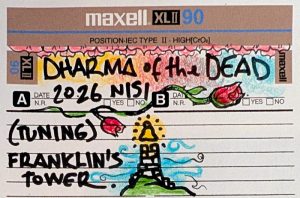
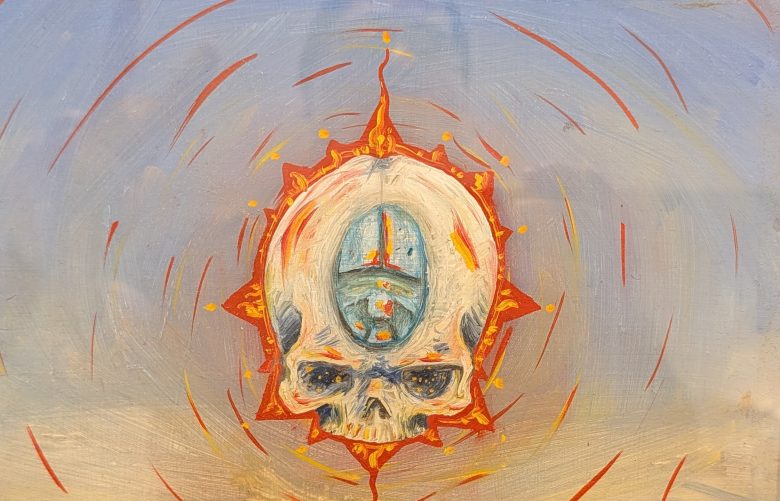
An opening reflection for the Dharma of the Dead series — a bit of tuning before the first song.
Welcome to the first post in the Dharma of the Dead series. It’s been a long time coming. Over the span of my life with The Grateful Dead, which didn’t formally begin until the late 1980s and early 1990s, I grew to believe that their lyrics held meaning beyond their words. The collaborations between Garcia/Hunter, Weir/Barlow, Lesh/Petersen, among others, may have begun as psychedelic poetry and abstract storytelling, but their emotive themes and the epic nature of their catalog beg for deeper exploration. I don’t think this is an uncommon experience among Deadheads. As such, these posts will include commentary from other teachers and Deadhead friends in the dharma community along with an invitation for you to engage directly as well.
The hermeneutic spiral (what I sometimes refer to as “time-released insight”) is tangible as the songs and lyrics ripen alongside our lives, unfolding and revealing insights that are sometimes shared by the collective consciousness and sometimes held very close to our own hearts. The late, great Bob Weir once said, “If we serve this legacy, it’ll go on and people will teach this in music school in 200 or 300 years.” I’m planting this series as a seed — a way for me to stay in conversation with these lyrics, and an invitation for you to foster that dialogue in your own way. Maybe it will even grow into a book someday, another way of serving this legacy.
This way of returning to a text again and again has deep roots. Throughout Buddhist history, commentary has been a way of keeping teachings alive — not as fixed doctrines, but as texts that reveal new layers when read through the lens of each generation’s experience. In the Tibetan lineages I study with, this is understood as a living conversation with the teachings, where meaning ripens over time rather than remaining static — a tradition I hope to honor in my own small way with this project.
I dedicate this project to all members of The Grateful Dead both living and gone beyond as well as the long lineage of musicians, poets, and artists that they belong to.
May it be of benefit.
May the music never stop.
May all beings be free.
Notes
Some posts in this series include Tibetan script or terms. I’m a student of these traditions and still learning the language, so any errors are mine. I include these elements with respect and as part of my own practice, not as an authority.
Excerpts used for commentary under fair use. Lyrics ©1965-1995 their respective copyright holders.