“Sticking with that uncertainty, getting the knack of relaxing in the midst of chaos, learning not to panic — this is the spiritual path.” — Pema Chödrön
There’s something that happens when I’m caught in the trap of duality, suspended between feeling too much and not wanting to feel anything at all. My mind starts to race, looking for a safe place to land, but because everything feels uncertain, it just keeps moving. This shows up in personal, relational, and work situations — but also as a kind of default state in the deluge of media and the intensity of messaging that saturates today’s political and social climate. Uncertainty like this can feel like a direct threat. Whether the situation is real or imagined, the mind can react as if there were a grizzly bear in the living room, abandoning peace and clarity for discomfort, distraction or worse.
On one end of the spectrum are strong emotions — outrage, sadness, grief, fear. On the other end is a very sane desire to look away, to distract ourselves, or even shut down altogether — an instinctual form of self‑preservation. The emotional fatigue of a heart stretched thin is real and valid. The anger over injustice is valid. The fear that arises during a family health crisis is valid. The need for space from it all is real and valid. These are natural responses to witnessing life unfold in a chaotic moment of human history, or more personally, in a difficult moment of our own lives.
And while some well‑intentioned part of me whispers that all moments in human history are chaotic, this is the moment I’m living. This is the moment my heart and mind are reacting to directly. Maybe you’re feeling something similar. And like me, you may be wondering how to pull the lens back a bit and find some middle way between these extremes of feeling too much or not at all.
One approach I’ve come to rely on for shifting my view out of the extremes of overwhelm and disconnection comes from the practice of shamatha (peaceful abiding) meditation. We try to stay with our experience just a little longer than we may be comfortable with — not forcing anything, not pushing into trauma, just light effort to stay with the moment. Noticing, or even gently labeling, the strong emotions and thoughts that arise. Noticing the aversion to them. Noticing our desire for things to be different. All the while softening judgment. This simple inner posture begins to loosen the grip of the extremes, allows for the heart to hold more, and offers the mind a little spaciousness. Spaciousness without distraction. Sustainable spaciousness.
Ultimately, working with peaceful abiding creates the conditions for innate wisdom, and inner peace to come forward. As space opens, the dualistic extremes begin to lose their solidity. The nervous system grounds and regulates and we might even start to feel a bit of respite even in these difficult and trying times.
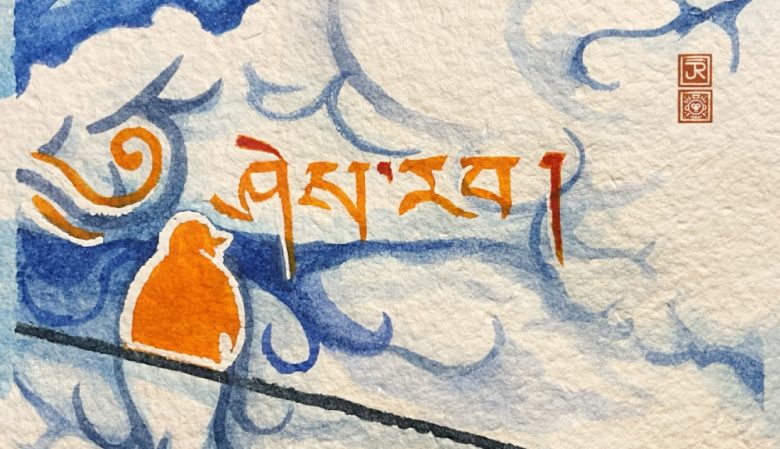
“Good and bad, happy and sad, all thoughts vanish into emptiness like the imprint of a bird in the sky.” — Chögyam Trungpa
In Buddhist philosophy, this is referred to as prajñāpāramitā — often translated as the “perfection of wisdom.” It points to a direct seeing of the lack of solidity in all phenomena including extreme thoughts or emotions, a sense of non‑dual experience sometimes described as emptiness. This emptiness isn’t a void, but the absence of a fixed, permanent essence. Not empty in a nihilistic, checked‑out way, but empty of the solidity that makes these emotional states feel so heavy and permanent.
We’re aiming for balance — a middle way between feeling too much and numbing out. From here, we can engage with our lives more fully, even when things feel chaotic.
Over time and with some effort applied we might even start to trust that this open space of mind is always available to us. This trust is not a “blind faith” situation, rather it is gained through personal experience and reflection.
This approach is strengthened by a daily meditation practice. It is not a one-and-done. There’s a reason it’s called a practice. If you’re interested in starting a personal meditation practice — or deepening the one you already have — let’s talk.